Who's Stalking Now?
QUOTE
Who's stalking now?
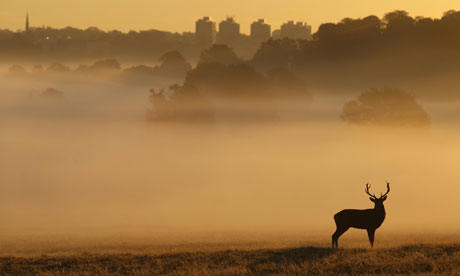
When the first deer appears, seemingly
from nowhere, I swing the rifle round too quickly and it spots the
movement, vanishing without a sound. We wait a few frozen minutes up in
the high seat, until the stalker decides it isn't coming back, and
whispers that we should hunt from the ground. Once I'm halfway down the
ladder, the muntjac skitters past almost in mockery.
There are probably more deer living wild in the UK than ever. No one knows how many; they are secretive, wide-roaming animals, and populations fluctuate each year. But they breed quickly, lack predators apart from humans, and are superbly adapted to life in the British countryside. These islands' six free-living species total well over 1m animals, who thrive even though 350,000 are shot and 74,000 are involved in car accidents every year.
Anti-hunting, pro-animal charities and much of the general public question the ethics of stalking. "It's a blood sport, a branch of the entertainment rather than the food industry," says Alistair Currie, policy adviser for PETA. "Many of the animals are not killed instantly, and the killing of individual animals by hunters leads to changes in the local deer population which lead to other stresses." What of farmers whose crops are damaged or destroyed by deer? "As ever with human dealings with animals," says Currie, "the solution is a lethal one. Fences keep deer out." (People involved in deer management claim that putting up costly fences and letting nature control deer numbers condemns many deer to starvation, and many more to acute hunger.) A spokeswoman from the League Against Cruel Sports tells me it's "crazy" that "untrained people are allowed to go out and shoot deer. At the absolute least, we think there should be a minimum competency of gun use before people are allowed to stalk them."
With Darren "Phiz" Phizacklea, a professional stalker, and Andy McLeish, executive chef at the Michelin-starred Chapter One restaurant in Farnborough, Kent, I went to investigate. We visited an estate in southern England that didn't want to be named for fear of activists and poachers. Once we had a deer, the plan was to hang it, butcher it and cook it in the Chapter One kitchen.
Phiz won't let people stalk until they can hit three shots on a circular target, and then a "kill" shot on the paper silhouette of a deer at 100 yards. I'd never fired a rifle before, but guns are so accurate these days that I managed these immediately. You draw an imaginary line up the front leg and aim a little way above it. A shot will blast straight through the animal there – lung, heart – hit a deer in that spot and it might rear up or canter a few paces, but it's finished. You never shoot a wild deer in the head, which might rip off part of its jaw; without a trained dog to find it, it would be left to starve.
The need to ensure a clean kill was strictly enforced. Having a deer in your sights is not enough to take a shot. You always shoot broadside. Phiz's dog, a beautiful creature called Red, is trained to find and hold wounded deer: Phiz then catches up and makes sure the second shot is true. I ask how many times a year Red gets to do his party trick. "Two or three." And how many deer do you shoot every year? "A few hundred."
Andy slinks off on his own while Phiz and I creep through the forest, me in borrowed green overalls and the wrong hat. Odd noises break the silence: a squirrel scuttling up a tree, a crow's caw, the crack of a twig. I stand close behind Phiz, the loaded rifle swinging from his shoulder, its barrel pointing towards my face. Then he stops.
Two fallow deer stand above us up a hill. It's too far to shoot, so we stalk them, keeping as low as possible, using trees and ferns for cover. At last we're close enough. Roots web the ground, and there's no flat earth on which to rest the gun. I find them in the sights with my arms beginning to ache. One deer is standing in front of the other. I can't take a shot: a bullet could go through the first one and wound the one behind. The deer can smell us: they stay frozen, reading the forest. The one in front takes a wary step forward. Phiz whispers: "One more step and you can fire." I flick the safety catch off, close my finger round the trigger. Through the sight I make out the pelt of the creature's fur, the glint of its right eye. I wait, barely breathing, for it to take the final step. Finally, it turns round and lumbers calmly back into the forest. My hands are shaking when I stand up.
We jump at the sound of a shot. Andy is upset: he took a shot, but can't find the kill. There's no fur on the ground, no blood. In darkness now, Phiz and I trudge back to the Land Rover to pick up Red. The dog finds a scent immediately and leads us to the deer just 50 feet away, hidden in bushes. A fallow buck, a yearling, shot through the heart. The fur is spikier than you expect. As we drag the warm dead weight to the boot, Red laps at the dripping wound in a kind of ecstasy.
You have to gralloch deer quickly – within half an hour in summer – or the beast will start to stink [ That is tosh - Editor ]. Back at the euphemistically named larder, a tiled room with a drain in the middle, Andy removes the feet, hangs the deer upside down, cuts away pizzle and rectum with a mechanical frankness. The blind eyes stare as he slices the throat, and the head jerks repeatedly, as if in protest, as blood and viscera splatter on to the floor. Phiz checks the lymph nodes and liver for signs of disease. Eventually the windpipe peels from the neck like a garden hose, then Andy cuts the head from the body, still attached to guts and pluck. The smell is like dank vegetation; rank apples, ferrous and unforgettable. [ It is quite nice in fact - Editor ]
I visit Chapter One a week later for the butchery and cooking. Andy shows me how to place little nicks round tendons, cut round bones, yank away the skin with its strange ripping sound. One shoulder, matted with hair and dried, bloody grass, is mangled and useless, but the two legs, saddle and the other shoulder will make good cooking. Andy joints the animal, then separates each muscle from the leg, removing the sinewy silverskin that lies between them with a butcher's skill. His resulting recipes – bresaola and venison wellington with chestnuts and sprouts – are here.
Stephen Pinker, in his fascinating new book The Better Angels of Our Nature notes that while killing animals for meat is "part of the human condition", hunting is declining in popularity. The number of US households that hunt dropped from 30% to 20% between 1975 and 2005, while money spent on hunting fell by 15% (rising by the same amount for wildlife watching). Pinker see this as part of an ongoing trend against cruelty and sadism in the human species.
"It remains to be seen," he adds, "whether the decline [in hunting] will be reversed by the locavore craze, in which young urban professionals have taken up hunting to reduce their food miles and harvest their own free-range, grass-fed, sustainable, humanely slaughtered meat." The tone may be ironic, but he's right. That deer, free to forage for its food and live wild, enjoyed a better existence than a farmed chicken or pig. Its end was swift. And the desire to kill an animal for meat is not of itself sadistic: by necessity it implies a starker appreciation of the origin of food.
But if there is something bloodthirsty
in stalking, insofar as I – with zero kills to my name – experienced it,
it is not the infliction of suffering but the willingness to kill a
sentient creature for the satisfaction of finding one's own food. To
many meat-eaters, that pleasure may be curious and conflicted, but it is
not cruel.
UNQUOTE
The deer population is huge and to a large extent parasitic. They go to
our crops. So they live round us, near us, on us.
Locavores ex
Wiki
QUOTE
A locavore is a person interested in eating food
that is locally produced, not moved long distances to market. The locavore
movement in the United States and elsewhere was spawned as interest in
sustainability and eco-consciousness became more prevalent.
The word "locavore" was the word of the year for 2007 in the Oxford American Dictionary. This word was the creation of Jessica Prentice of the San Francisco Bay Area at the time of World Environment Day, 2005. It is usually rendered "localvore" by some, depending on regional differences.
The food may be grown in home gardens or grown by local commercial groups interested in keeping the environment as clean as possible and selling food close to where it is grown. One often cited, but not universal, definition of "local" food is food grown within 100 miles of its point of purchase or consumption.
Farmers' markets play a role in efforts to eat what is local. Preserving food for those seasons when it is not available fresh from a local source is one approach some locavores include in their strategies. Living in a mild climate can make eating locally grown products very different from living where the winter is severe or where no rain falls during certain parts of the year. Those in the movement generally seek to keep use of fossil fuels to a minimum, thereby releasing less carbon dioxide into the air and preventing greater global warming. Keeping energy use down and using food grown in heated greenhouses locally would be in conflict with each other, so there are decisions to be made by those seeking to follow this lifestyle. Many approaches can be developed, and they vary by locale. Such foods as spices, chocolate, or coffee pose a challenge for some, so there are a variety of ways of adhering to the locavore ethic.
A related movement is the 'underground
supper club' phenomenon, in which organizers use sustainable ingredients and
use a Website to inform a waiting list of those who donate a given sum to pay
for the food used.
UNQUOTE
It is
fun perhaps, an entertainment. Eating local meat for most people means rabbit
at best. Gutting them is a messy, smelly business.
Deer Management is a vital part of British Conservation
[ 12 April 2017 ]
QUOTE
One of the great paradoxes of British conservation is that the mammal which
most obviously has to be culled in the largest numbers to protect
biodiversity, is also the one which the public is least comfortable with
being killed. Whether it is because of Bambi, big eyes, or majestic form
deer are close to the hearts of British people. Unmanaged populations of
both indigenous and introduced deer species in the countryside can, however,
be disastrous for many other species of both flora and fauna, as well as the
health of the deer themselves.
New research published this week, and widely reported, has used modern technology to show that woodlands with high deer densities differ in their structure not only in the understorey, where deer are able to browse, but throughout the whole canopy profile which affects birds, small mammals, insects and many other species, as well as tree recruitment and regeneration.
As the League Against Cruel Sports proved so conclusively at its land holding in Somerset, refusing to manage deer populations (in that case red deer) will also lead to individuals dying slow and agonising deaths from disease and starvation. On one occasion LACS’s own stalker blew the whistle after having to dispose of 107 dead or dying deer in 12 months on just 300 acres. Such abdication of responsibility is rightly considered gratuitous cruelty by responsible deer managers and is thankfully rare. There is, though, a significant problem with keeping on top of the burgeoning deer population, which is thought to be higher now than at any time since the Norman invasion.
There are simply too many deer in many parts of our island and they are having a very significant impact on lowland habitats, especially in woodlands where their browsing removes the understory which is crucial for many other species. Woodcock, for instance, are thought to be in decline as a breeding species in the UK, reversing an upward trend throughout the 19th and 20th century. The Game and Wildlife Conservation Trust believes that habitat degradation driven by high deer densities is playing a significant role in the decline.
The reasons we cannot keep deer numbers in check are complex. In part it seems to be cultural as stalking and deer management play second fiddle to game shooting across much of the UK, whereas the opposite is true on the continent. In part it may be the complicated patterns of land ownership and sporting rights in this country, allied with the difficulty of managing such species when they move into areas of human habitation. Then there are the political difficulties for institutional land owners of any cull of wild animals, let alone one as attractive as deer.
But whatever the difficulties they must be overcome if we are to keep the deer population at a sustainable level. This is a challenge certainly, but also an opportunity to show how important wildlife management is to the conservation of the countryside we love.
Tim Bonner
UNQUOTE
The
Countryside Alliance comes across as a straightforward bunch albeit not
many of them vote Labour.
The LACS finances look all right are in good order, it is a highly profitable mob - see LACS Accounts but they only tell half the story. Assets being sold, legacies falling - see The League Against Cruel Sports - is it going 'all in' - Shooting UK. A freedom of information request was made to the Home Office regarding the LACS - The League Against Cruel Sports - is it going 'all in' - Shooting UK - get copies by phoning 020 7035 1029 quoting reference number 19603.
Cameron Misses His Annual Deer Stalking Holiday [
30 November 2014 ]
Cameron
alleges that he hurt his back.
Cameron is a liar.
Cameron wants votes. Annoying the anti-shooting
lobby is not going to help.
League Against Cruel Sports accused of starving deer on its own sanctuary
QUOTE
Dozens of deer are dying of starvation and disease on a sanctuary
owned by the
League Against Cruel Sports because the anti-hunting group
refuses to allow any form of culling.
Shocking pictures, showing the desperate condition of deer at the Baronsdown sanctuary near Baronsdown, near Dulverton in Somerset, have been passed to The Telegraph by the league's own deerstalker in an attempt to force the group to manage the animals humanely.
Gordon Pearce, who has been employed by the league for more than 30 years to put down injured or diseased red deer, claims that his employers have ignored his repeated warnings that some old or diseased animals must be culled to prevent others in the 350-strong herd from dying of starvation or disease.
Mr Pearce says that in the 12 months to April this year, 107 deer were found dead or dying at the 225-acre sanctuary, which was set up in 1959 to prevent deer being killed by hunts.
"The majority of the call-outs I have attended have been for deer which were starving," he said. "If these were farm animals the league would be prosecuted for neglect. As the population has increased, the deer's condition has deteriorated dramatically. The problem has been growing over the last few years so that now I feel compelled to speak out publicly.
"Half of them need to be culled so that the others are given a chance to be healthy. The general condition of the deer is such that if they were mine I would not want a friend to see them because I would be ashamed. They are listless, barely able to get up when people approach. The state they are kept in is cruel, it is that simple."
As the population mounted and the health of the herd declined, Mr Pearce - himself an opponent of hunting - drew his concerns about their health to Douglas Batchelor, the league's chief executive.
Mr Pearce said: "I told Douglas Batchelor about the problems with the deer and said they could not just give them hay because they needed more food. Some of the land should be ploughed and swedes planted and there should be more pasture provided.
"I also told him the deer were becoming interbred because the stags were serving their own daughters and granddaughters. The deer were becoming smaller as a result.
"He did assure me he would mention it to the league's committee and tell me what they decided but when I called him later he told me to mind my own business.
"When I said that I would go public, he told me that what I was doing was political. I have been trying to bring this to their attention for four years and they have just laughed in my face."
Worries over the welfare of the deer were voiced at the league's annual general meeting in March last year. Minutes of the meeting read: "The unnatural concentration of deer on the sanctuary will eventually lead to deer health problems more commonly associated with deer farming.
"One possible course of action would be to commission a report from a reputable and independent expert on the 'management' options open to the league with regard to the wild deer population and the development of a 'deer plan' for the sanctuaries." The league subsequently decided that it did not have a problem.
Mr Pearce, who at 72 has nearly six decades of deer management experience, including having worked intermittently for the league since the 1960s, took photographs showing the poor state of the animals he has been forced to put down.
"In most cases the deer were so malnourished they could not get up," he said. "On one occasion a league worker called me to say a big stag had a broken back leg but that I could not shoot it until the sanctuary manager, Paul Tilsley, said okay.
"But he was on his way to London. By the time he got back and agreed the stag had to be shot it was nearly two weeks later and for all that time it had been in agony, with a broken leg.
"Everything had to be put to the league committee in London, which is no way to run a deer sanctuary in my opinion. Paul does not want any animal to die and I can appreciate that entirely, but I question whether a man who is very sentimental like that should make a decision on whether an animal in pain should be despatched."
Some of the deer, which are not restricted to the sanctuary but return to it to feed, have also been found dead on adjacent land. Diana Scott, joint master of the Devon and Somerset Staghounds which are kennelled nearby, said: "We have perceived there is a problem with the health of the deer at Baronsdown for a while but Mr Pearce has produced the most compelling evidence yet.
"He does not support hunting and to come out and criticise the league he must have been desperate."
Simon Hart, the director of the campaign for hunting with the Countryside Alliance, said that the state of the deer at Baronsdown provided an example of what could happen to the general fox population if hunting is banned.
He said: "What this shows is that the so-called management alternatives put forward by the league for life after a hunting ban lead to an increase in suffering for wild animals. It is a glaring example of what not to do."
Mr Batchelor said: "Gordon Pearce brought his views to our attention. We have listened to what he's said, looked at our land and its carrying capacity, looked at the number of deer on it and the health of them and come to the conclusion that we do not need to cull any deer.
"Therefore we have not taken his advice. We have listened to his views but we disagree with him. Nature is the biggest controller of deer populations due to the weather, basically. If it's cold and wet you will get losses due to hypothermia and those tend to be in the younger animals.
"We asked the British Deer Society to look at what we were doing about two years ago and they found they were in good health. I must admit we didn't repeat that exercise following Gordon Pearce's comments.
"The guts of it is that they are wild deer and we provide a sanctuary. People say, 'You should manage your deer', but we don't see the need to manage by elimination."
The League Against Cruel Sports was founded in 1924 by disgruntled
members of the RSPCA. It lobbies politicians to press for a ban on
hunting with dogs.
UNQUOTE
The LACS has managed to keep this truth out of the
Wikipedia;
in fact it wasn't much reported. There were financial shenanigans I seem to
recall.
